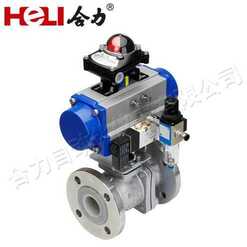

简介:
气动球阀是一种广泛应用于各种工业领域的控制阀门。它们由多个部件组成,可通过气动装置实现开关控制,具有结构简单、操作方便、维护容易等优点。本文将介绍气动球阀的工作原理、特点和应用范围。
正文:
工作原理
气动球阀的工作原理基于球体旋转,用以控制管路中的流体流动。它的结构由球体、阀座、阀杆和驱动机构组成。当气动装置提供压缩空气时,气压通过气管进入阀体,推动活塞移动,进而转动球体,使球体上的通道与管路的通道相连通或者隔离。当压缩空气停止供给时,弹簧会将阀芯压回原位,球体也会回到原来的位置,从而关闭管道,实现流体的控制。
特点
气动球阀具有以下特点:
(1)结构简单:气动球阀由少量部件组成,安装和拆卸方便,维护简单;
(2)操作方便:通过气动装置的控制,可以远距离控制气动球阀的开关状态,操作简单;
(3)快速响应:气动球阀的响应速度快,能够快速打开或关闭管道;
(4)适应性强:气动球阀的材质多样,能够适应各种不同的介质和工作环境;
(5)安心可靠:气动球阀在高温、高压等极端环境下也能够保持稳定的工作状态,具有较高的安心性和可靠性。
应用范围
气动球阀广泛应用于以下领域:
(1)化工行业:用于流体控制和调节;
(2)石油行业:用于管道的切断和流体调节;
(3)电力行业:用于热力管道和冷却水系统的流量控制;
(4)制药行业:用于洁净室、生产流水线等的流体控制和调节;
(5)食品行业:用于食品加工和输送流体的控制。
结论:
气动球阀作为一种常见的控制阀门,在工业生产中具有重要的作用。它的结构简单、操作方便、维护容易,具有快速响应、适应性强、安心可靠等特点。在化工、石油、电力、制药、食品等领域都有广泛的应用。未来随着工业自动化程度的提高,气动球阀的市场需求将进一步增加。同时,随着科技的不断发展,气动球阀也会不断创新,应用范围将会更加广泛,为工业生产提供更多便利和保障。
参考译文:
Title: Working Principle and Applications of Pneumatic Ball Valves
Introduction:
Pneumatic ball valves are widely used control valves in various industrial fields. They are composed of multiple components and can be controlled by pneumatic devices, featuring simple structure, easy operation, and easy maintenance. This article will introduce the working principle, characteristics, and application scope of pneumatic ball valves.
Body:
Working Principle:
The working principle of pneumatic ball valves is based on the rotation of the ball to control the flow of fluid in pipelines. Its structure consists of a ball, a seat, a stem, and a driving mechanism. When compressed air is supplied by the pneumatic device, the air pressure enters the valve body through the air pipe, pushes the piston to move, and then rotates the ball, allowing the passage on the ball to connect or isolate with the passage in the pipeline. When the compressed air stops supplying, the spring will push the valve core back to its original position, and the ball will also return to its original position, thereby closing the pipeline and controlling the fluid.
Characteristics:
Pneumatic ball valves have the following characteristics:
(1) Simple structure: Pneumatic ball valves are composed of few components, and they are easy to install and disassemble, and easy to maintain.
(2) Easy operation: By controlling the pneumatic device, the opening and closing states of the pneumatic ball valve can be remotely controlled, and the operation is simple.
(3) Fast response: Pneumatic ball valves have a fast response speed and can quickly open or close pipelines.
(4) Strong adaptability: Pneumatic ball valves are made of various materials and can adapt to various media and working environments.
(5) Safe and reliable: Pneumatic ball valves can maintain stable working conditions even in extreme environments such as high temperature and high pressure, and have high safety and reliability.
Application Scope:
Pneumatic ball valves are widely used in the following fields:
(1) Chemical industry: used for fluid control and regulation;
(2) Petroleum industry: used for pipeline cutting and fluid regulation;
(3) Power industry: used for flow control of thermal pipes and cooling water systems;
(4) Pharmaceutical industry: used for fluid control and regulation in clean rooms and production lines;
(5) Food industry: used for fluid control in food processing and transportation.
Conclusion:
As a common control valve, pneumatic ball valves play an important role in industrial production. They feature simple structure, easy operation, and easy maintenance, and have the characteristics of fast response, strong adaptability, and safety and reliability. They are widely used in chemical, petroleum, power, pharmaceutical, and food industries. With the increase in industrial automation and the continuous development of technology, the market demand for pneumatic ball valves will further increase in the future. At the same time, with the continuous innovation,